
Case studies · New England
What twelve months of SEO actually looks like
Most of our work is on the North Shore, but search engines do not care where anyone sits — these two are a practice in Massachusetts and one in New Hampshire. Every number comes from Google Search Console and Google Ads, the client's own accounts, not our estimates. Client names are left out; the industry and the state are enough to judge whether the work applies to you.

Case study 01 · Developmental services practice, Massachusetts
He tried to build it himself first. Then he gave us six weeks.
The owner had started the website on his own and it wasn't going anywhere. When he came to us there was no traffic, no rankings, and no listings — the site was effectively invisible. We agreed a target rather than a retainer: a working website, the assets sorted out, and SEO in place well enough to land his first client within six weeks.
The first six weeks
All existing assets optimized. The site restructured so every service the practice offers has a page of its own instead of being buried on one page. Local listings built and verified. The first PR article published. And the first keyword strategy written and applied, so the pages were targeting terms a parent would actually type.
The first client came in within the window. More followed. Twelve months on, we run monthly SEO and Google Ads for the practice.
Twelve months of organic search
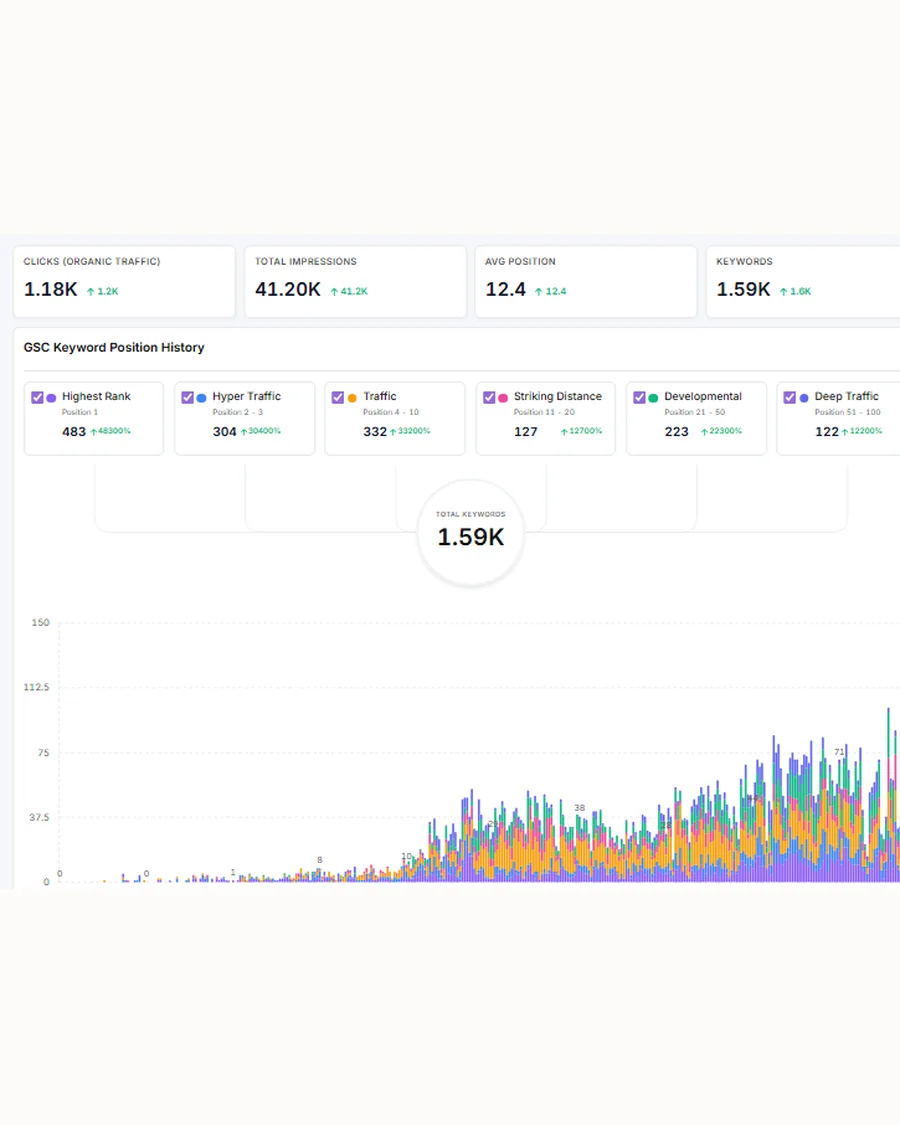
The site started from nothing, so every one of those is growth from zero. Average position across all 1,590 terms is 12.4 — roughly the top of page two — and 483 of them sit at position one. Search Console recorded almost no activity until late January, then a rise that has continued month over month since.
Paid search, running alongside
The campaign runs on a narrow list of terms chosen with the owner, and nothing else. Keeping it narrow is what holds the cost per click down — broad keywords are cheaper to bid on and far more expensive to convert. For a practice this size, a few of the right clicks is worth more than a lot of the wrong ones.
Case study 02 · Dentist practice, New Hampshire
The site wasn't the problem. The platform underneath it was.
This practice already had a website and already had us working on it. For months the numbers barely moved. The site was built on a drag-and-drop builder that gave us no real control over structure, page speed or the technical work search engines respond to — we were optimizing around the tool rather than the business.
In January 2026 we moved the practice off it and onto a platform we could actually work with. At the same time the owner increased the monthly budget. Both things changed at once, and both matter — the platform removed the ceiling, and the budget paid for the work that filled the space above it.
Fourteen months, before and after the move
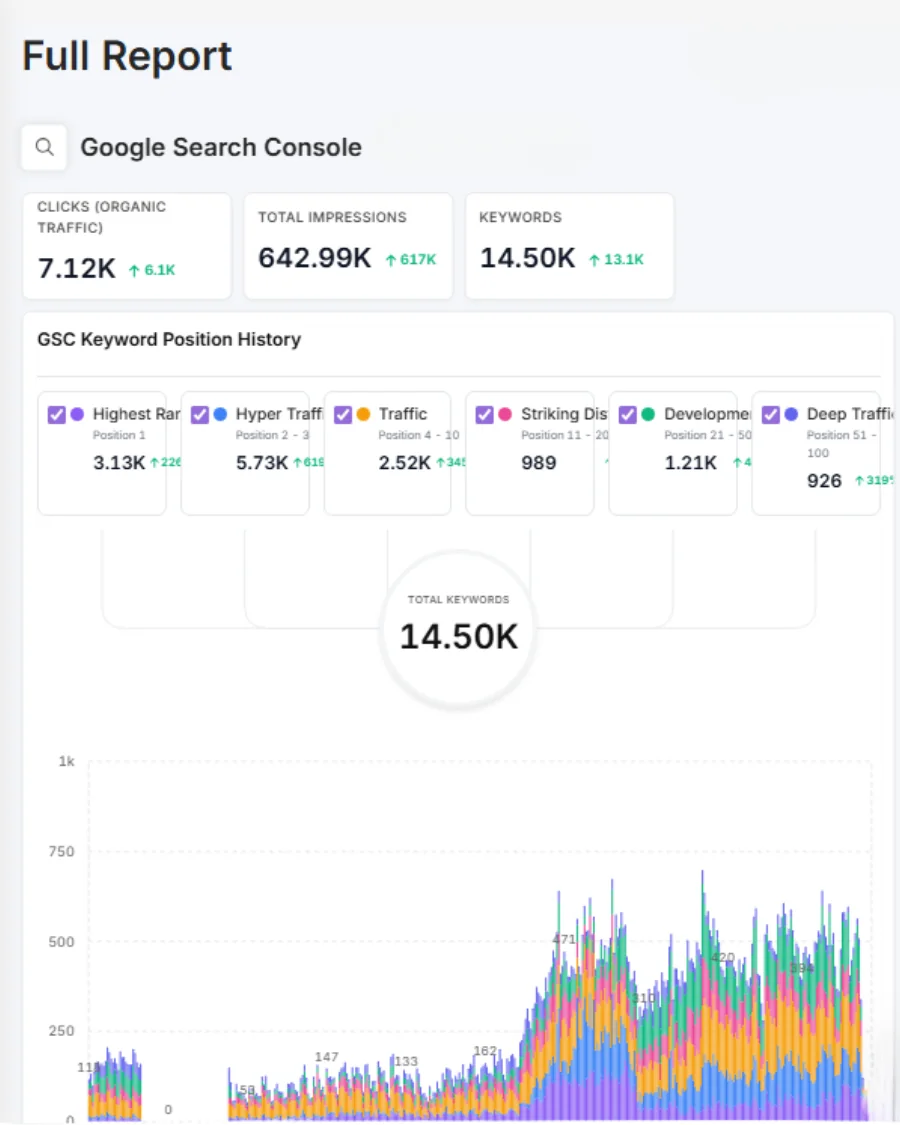
Roughly seven times the clicks, twenty-five times the impressions, and ten times the number of terms the practice appears for. Beyond the 3,130 first-place rankings there are another 5,730 sitting at position two or three — the results a searcher sees without scrolling.
The chart tells the honest version of the story. Before the move it hovers between one and two hundred and stays there month after month. From January it climbs and keeps climbing. Nothing about the practice changed. What changed was what we were allowed to build on, and how much of it we could do each month.
Why this one took longer
Migrating an established site is slower and riskier than building a new one. Every existing URL needs a redirect or the rankings you already have disappear overnight. That's unglamorous work with no visible payoff — you only notice it when someone skips it.
SEO is monthly work, and this is what monthly work looks like on a chart. Consistent presence compounds. There is no version of this where the same result arrives in six weeks.
Reading these honestly
What these numbers do and don't tell you
Where you start changes everything
The first grew from nothing, so the percentages look enormous — a new site has nowhere to go but up. The second was an established site, slower and riskier because there are rankings to lose. Neither pattern predicts yours.
Clicks are not clients
1,180 clicks over a year is real traffic for a local practice, but traffic is only the part we control. Being visible and being chosen are two different jobs, and only the first shows up in a ranking report. What happens after someone lands on the page depends on the offer, the pricing and how quickly the phone gets answered.
It took months, not weeks
The first practice landed a client inside six weeks because a working site and correct listings move quickly — but the search curve took until late January to lift at all. The second took over a year to reach these numbers. Anyone promising rankings in thirty days is describing something other than SEO.
Two changes at once
In the second case the platform moved and the budget rose in the same month. We cannot tell you which mattered more, and neither can anyone else. What we can say is that the old platform was a ceiling — no amount of budget was getting through it.
What clients say
Every review on Google is five stars
Our website and code needed work and she put in the time to fix a lot of issues. Within a few months I saw organic traction to our website and clients outreach increase because of her SEO optimization tools and skillset.
BonBonica did a great job of helping my business increase our Search Engine Optimization ranking and now we are getting more phone calls, leads and business because of their efforts.
How the work is put together
Same order every time
The website and the service pages first — structure before design, one page per thing you sell, written by hand so it loads quickly. Only then the Google profile and the listings, because those point at the site and there is no sense sending people to a page that cannot answer them. Then ongoing SEO, which is where the slow compounding happens.
Paid ads come last, and only when the maths works for your margins. Running ads to a page that doesn't convert is a way to spend money learning something a free analysis would have told you.

Questions about these results
Questions we get asked
Are these real numbers?
Yes, taken directly from the clients' own Google Search Console and Google Ads accounts. Nothing is estimated and nothing is rounded up. Client names are removed; the numbers are not edited.
Why are the clients anonymous?
Because the figures are their business data, not ours. The industry and the state are enough for you to judge whether the work applies to you. Google reviews are the exception, since the reviewer published them publicly under their own name.
Will I get the same results?
Almost certainly not, and anyone who promises otherwise is guessing. Different industry, different market, different starting point. The only way to know is to look at your site against whoever is currently outranking you.
How long did these take?
One took twelve months from a brand-new site. Another took fourteen and needed a change of platform partway through. The first enquiry in both cases came far earlier than the search numbers did.
Start here
Find out where you stand before you spend anything
We look at your site against the businesses currently outranking you in your towns and tell you what we'd change. Free, no obligation, and yours to keep. Text +1 781-513-8746, email maida@bonbonica.com, or book thirty minutes.
- Phone
- +1 781-513-8746
- maida@bonbonica.com
- Hours
- Monday–Friday, 7:00 AM – 3:00 PM · Saturday, 10:00 AM – 1:00 PM
- Based in
- Swampscott, MA