
Starting out
You opened the business. Nobody can find it.
The sign is up, the licence is filed, the website exists. And the phone does not ring. Three months in, most owners assume they need to spend more. Usually they need to fix four things that cost nothing, and then spend.
This page is what those four things are, in the order that works.

Why the phone is not ringing
A new business is invisible in four specific places, and most owners only know about one of them.
You are not in the map. When someone nearby searches for what you sell, Google shows three local businesses above everything else. That block is decided by a Google Business Profile, not by your website. If you have not claimed and completed one properly, you are not eligible to appear there — and for most local searches, that is the entire transaction.
Your website does not say what you do. Not in the way a search engine reads it. A page headed "Welcome" with a paragraph about your passion tells Google nothing about what you sell or where. The words in your page titles are what get matched against what someone typed.
You have no listings anywhere else. Directories, the chamber, industry lists. Each one is a small confirmation that the business is real and where it says it is. A business with none of them looks, to a search engine, like it might not exist.
Nobody has reviewed you. This is the one that feels unfair, because you cannot have reviews before you have customers. It is also the one that changes fastest once you start asking.
What to fix, in what order
First, the Google Business Profile. It is free, it takes an afternoon, and it is the fastest thing on this list to move. Categories chosen precisely, every field filled, real photos, the service area set correctly. Most owners do a version of this in ten minutes and stop. The difference between ten minutes and an afternoon is usually the difference between appearing and not.
Second, the pages of the website. One page for each thing you sell, with the title naming that thing and the place you sell it. A single page covering everything ranks for nothing, because a search engine matching a specific question to a general page finds a weak match every time.
Third, the listings. Wherever a business like yours is expected to appear. The same name, the same address or service area, the same phone number on every one of them.
Fourth, ask for reviews. From real customers, without incentives. The first five change how the listing performs more than the next fifty.
Start with something to show
Before anyone can find you, there has to be something worth finding. That is what the free programme on this site is for.
The 7-Day Content Engine is seven short lessons, one a day. You take something you already know and turn it into a guide worth giving away, build a page that collects email addresses, set up the list, and learn how to tell people it exists without feeling like a salesperson. By the end you have a product to point at, a growing list of people who asked to hear from you, and a week of content from a single video.
No agency, no retainer, no card. The lessons are on this site and free to read.
Most of that reaches people through social media rather than search, and that is the point — it works while the slower search work is still building. Some owners get stuck at the setup and want it done for them; there are three paid options for that, starting at a video.
If you want to try the search side yourself too, start with the on-page work — titles, descriptions, headings, one page per service. Your hosting provider usually has a guide for it, and on WordPress a free plugin like Yoast or Rank Math walks you through it page by page. It is slower and it takes more learning than the seven lessons do. When you would rather not spend the time, that is what we are for.

What six weeks looked like for one owner
A practice in Massachusetts had opened and the owner had built the website himself. It was not going anywhere. No traffic, no rankings, no listings — the site was effectively invisible, which is the same position most new businesses are in without knowing the word for it.
We agreed a target rather than a retainer: a working website, the assets sorted, and enough SEO in place to land his first client within six weeks.
What that took: every existing asset optimised. The site restructured so each service had its own page instead of being buried on one. Local listings built and verified. A first PR article published. And a keyword strategy written and applied, so the pages targeted the terms a customer would actually type rather than the words the owner would have chosen.
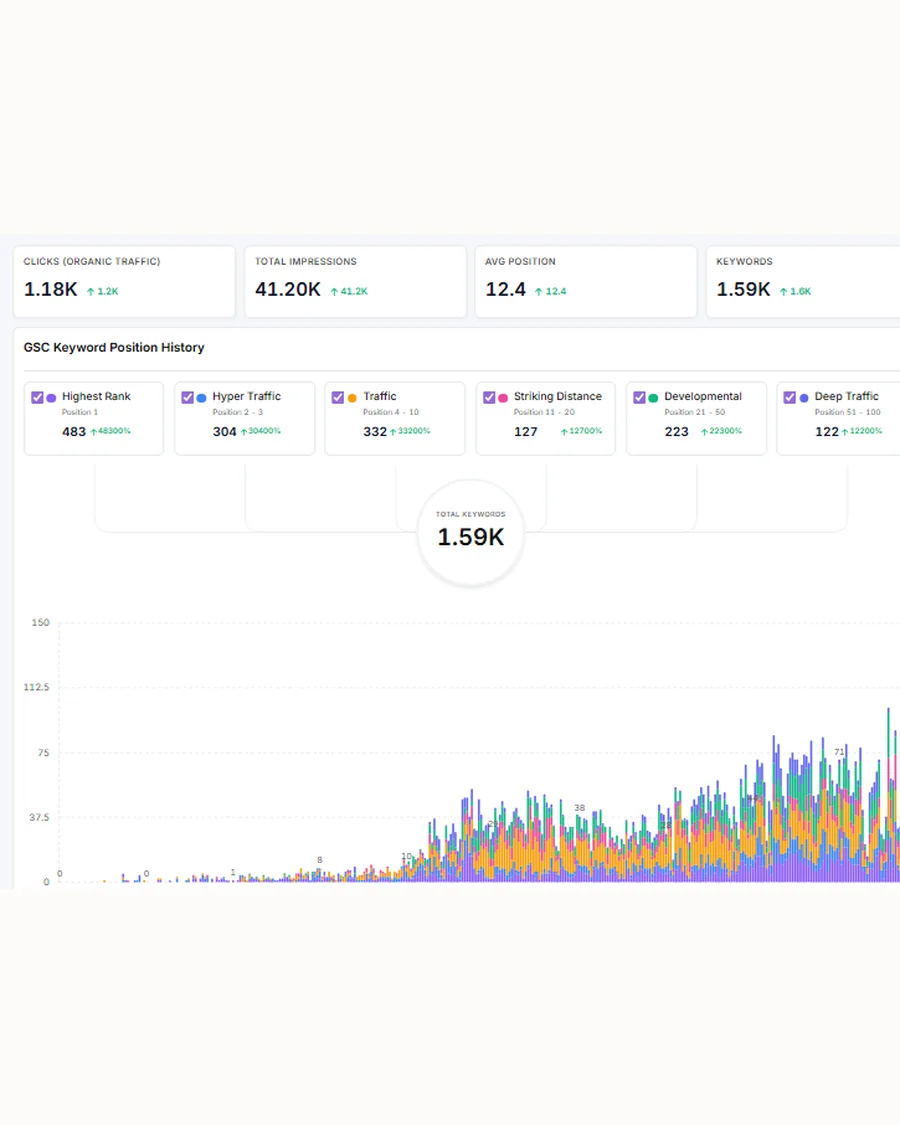
The first client came in inside the window. More followed. Twelve months later the site had 1,180 clicks from Google, 41,200 impressions, and 1,590 keywords ranking — 483 of them in first place. All of it from zero.
Those are the practice's own Search Console figures, unedited. The client name is left out, here and everywhere.
What this does not fix
Traffic is not customers. Getting found is the part an agency controls, and it is the smaller half of the problem. Whether someone who lands on your page becomes a customer depends on the offer, the price, and how fast the phone gets answered. An agency that presents traffic as revenue is describing half the job and charging for the whole of it.
The first months are quiet. The Google listing can produce enquiries within weeks, and that is genuinely fast. The search rankings behind it took until the third month to move at all in the case above. Anyone promising rankings in thirty days is describing paid advertising, or describing nothing.
Where you start changes everything. That practice grew from zero, which makes the percentages look enormous — anything divided by nothing is a large number. A business with some existing traffic grows more slowly and has more to lose. Neither pattern predicts yours.
Starting out
Questions we get asked
I just opened. Is it too early for SEO?
It is the right time for the free parts — the Google listing, the page titles, the listings elsewhere. Paid monthly work makes sense once there is a business to send traffic to and margin to pay for it.
Can I do this myself?
All of it, yes. Fix the listing, add the page titles and descriptions, get on the directories, ask for reviews — all of it is documented and free to find. None of it is secret; it is unfamiliar, the way your work would be unfamiliar to me. But it is work, and most of it is invisible until it starts paying. An agency is what you pay for when you would rather spend those hours on your own work.
Is SEO something you finish, or something you keep paying for?
It is monthly work, and the reason is that it compounds. Each month adds another page, another listing, another mention — and what it builds is not a ranking but a pattern. Search engines start treating the business as a known thing rather than an uncertain one, and so do customers, who see the same name turn up in enough places to trust it.
That matters more now than it did two years ago, because "search engine" no longer means Google and Bing alone. People ask ChatGPT, Claude, Gemini and Grok what to buy and who to hire, and those answers are assembled from sources the model can identify and trust. A business with a consistent name, clear pages and structured data gets quoted. One without gets left out — and there is no ranking report that tells you it happened.
How long before I see anything?
The Google listing can produce enquiries in weeks. Search rankings usually show nothing measurable for about two months, then move steadily.
What does it cost?
SEO packages run from $2,000 to $10,000 a month depending on how competitive the market is. Every range is published on the SEO services page.
Do I need a new website?
Not always. Sometimes the site is fine and the listing is the problem. The free analysis says which.
What is the free analysis?
A review of your site against whoever is currently ranking above you, with a written account of what would change. No cost, no obligation.
Start here
Find out where you stand, free
Text or call 781-513-8746, email maida@bonbonica.com, or book a free analysis of your site against whoever is currently above you.
Bonbonica works from Swampscott, Massachusetts, with businesses across the state and beyond.
- Phone
- +1 781-513-8746
- maida@bonbonica.com
- Hours
- Monday–Saturday, 7:00 AM – 3:00 PM
- Based in
- Swampscott, MA